Online Magazine
Recent Posts
- Safeguard your Cellphone Photos
- Black & White to Color – Instantly
- Wearing Many Hats
- Video Roundup
- Rescuing Your Blurry Pictures
- Showing Their Age
- What is Your Angle?
- Panorama Photos
- Humorous Photos
- Close Ups
- Fisheye Pictures
- Photo Antiquities
- Printing Big
- Appreciating Scale
- Celebrity Sightings
Tags
More Places to Go
- Free "How-To" Books “How To” books for popular cameras 0
- Vist Us on Facebook keep in touch with us on Facebook 2
Archives
- July 2023 (1)
- March 2023 (2)
- February 2023 (1)
- December 2022 (1)
- October 2022 (1)
- September 2022 (8)
- August 2022 (9)
- July 2022 (1)
- June 2022 (1)
- June 2021 (1)
- May 2021 (1)
- March 2021 (5)
- February 2021 (4)
- January 2021 (2)
- April 2019 (1)
- March 2019 (1)
- February 2019 (1)
- October 2018 (2)
- April 2018 (1)
- March 2018 (4)
- February 2018 (1)
- November 2017 (1)
- August 2017 (1)
- June 2017 (1)
- April 2017 (1)
- March 2017 (5)
- February 2017 (2)
- January 2017 (1)
- October 2016 (1)
- September 2016 (1)
- August 2016 (1)
- July 2016 (1)
- May 2016 (1)
- April 2016 (1)
- March 2016 (2)
- February 2016 (1)
- January 2016 (2)
- December 2015 (1)
- November 2015 (1)
- October 2015 (3)
- April 2015 (1)
- March 2015 (5)
- February 2015 (1)
- January 2015 (4)
- December 2014 (2)
- November 2014 (5)
- October 2014 (2)
- September 2014 (1)
- August 2014 (2)
- July 2014 (1)
- May 2014 (1)
- April 2014 (5)
- March 2014 (5)
- December 2013 (2)
- November 2013 (18)
- October 2013 (1)
- September 2013 (1)
- August 2013 (1)
- July 2013 (1)
- June 2013 (3)
- May 2013 (1)
- April 2013 (2)
- March 2013 (1)
- February 2013 (1)
- January 2013 (1)
- December 2012 (1)
- November 2012 (2)
- October 2012 (2)
- September 2012 (5)
- August 2012 (2)
- July 2012 (1)
- June 2012 (1)
- May 2012 (1)
- April 2012 (4)
- March 2012 (1)
- February 2012 (1)
- January 2012 (3)
- December 2011 (1)
- November 2011 (3)
- October 2011 (1)
- September 2011 (2)
- August 2011 (2)
- June 2011 (3)
- May 2011 (4)
- April 2011 (8)
- March 2011 (8)
- February 2011 (10)
- January 2011 (6)
- December 2010 (11)
- November 2010 (14)
- October 2010 (6)
- September 2010 (12)
- August 2010 (2)
- July 2010 (4)
- June 2010 (3)
- May 2010 (1)
- April 2010 (1)
- March 2010 (2)
- February 2010 (1)
- January 2010 (1)
- December 2009 (1)
- November 2009 (2)
- October 2009 (2)
- September 2009 (1)
- August 2009 (3)
- July 2009 (2)
- June 2009 (1)
- May 2009 (2)
- April 2009 (1)
- March 2009 (2)
- February 2009 (1)
- January 2009 (3)
Canon 5DS
23rd March 2015
WOW – 50MP Sensor
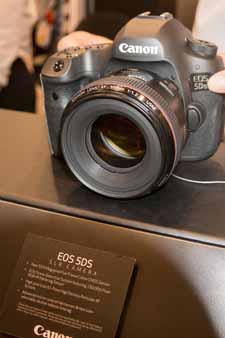
The Canon booth at Wedding & Portrait Photographers International Expo certainly drew a lot of visitors who wanted to view and ask questions about the upcoming Canon 5DS.
The reason for the crowds was Canon’s earlier announcement that this new camera features a sensor with a whopping 50MP! This is a giant leap in resolution compared to existing full-size sensor cameras.
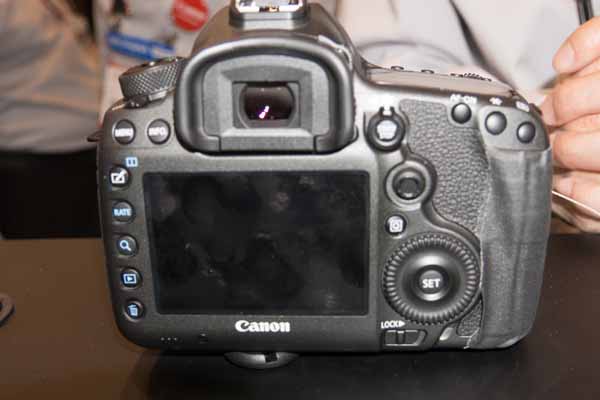
The camera body is remarkably similar to the 5DMkIII, both in size, weight, LCD monitor and controls. But it’s the inside where the action is. The sensor alone has more than twice the MkIII’s 22.3MP resolution. The 5DS uses a pair of the next generation DIGIC 6 processors to handle the additional pixel load.
A new feature lets you crop to either 1.3x or 1.6x to match the lens factors of the EOS 1D and APS-C respectively. In turn, camera blurs the cropped portion of the image in the viewfinder and provides resolutions of 30MP and 19MP. The mirror lock-up has also been improved to minimize camera shake. Canon has also added an intervalometer for time-lapse photography without requiring a remote control.
So while Canon has drastically increased the resolution of the sensor, the tradeoff is in the sensor’s sensitivity. The normal high ISO for the 5DS is 6400 compared to 25,600 for the 5DMkIII. So this is the price you’ll pay for higher resolution.
|
| |
 |
 |
 |
 |
|
| |
The 5DS autofocus uses the same 61AF points as the 5DMkIII. The metering is composed of 150,000 pixels RBG+IR found in the 7DMkII and is said to provide better exposures with artificial lighting.
In addition to the 5DS, Canon is also offering the 5DSR. The 5DSR cancels the low-pass filter to provide higher edge sharpness – useful for detailed subjects such as landscapes. Both cameras are scheduled for June release for prices of $3700 and $3900 respectively.
You’ll also notice that one of the photos above shows Canon’s new 11-24mm super wide angle zoom lens. This is not a fisheye, it’s a rectilinear but comes at a hefty $3000 price.
Written by Arnie Lee
What a View
27th August 2014
Wide Angle to the Extreme
It’s eye-catching when I see a photo that “bends” the horizon.
This bend comes from the camera’s lens. Use a very wide angle lens and you’ll see the curved “barrel” distortion on the images. One well-known type of wide angle lenses is the fisheye. These lenses typically have a field of view approaching 180 degrees – allowing you to capture the entire scene in front of the camera.
Until recently, fisheye lenses were expensive. I have one that cost well over $1500. But when I was looking for an ultra-wide angle for my Sony equipment, I found an inexpensive lens made by Rokinon. With its $300 price tag, I was a little skeptical of the quality of images from such a low cost lens but decided to try it regardless.
Here’s a short gallery of some of the scenes that I captured during my first outing with the lens a few weeks ago.
|
|
|
 This is an 8mm f/2.8 fisheye. I wanted an ultra-wide angle for an extra Sony Nex7 mirrorless camera. |
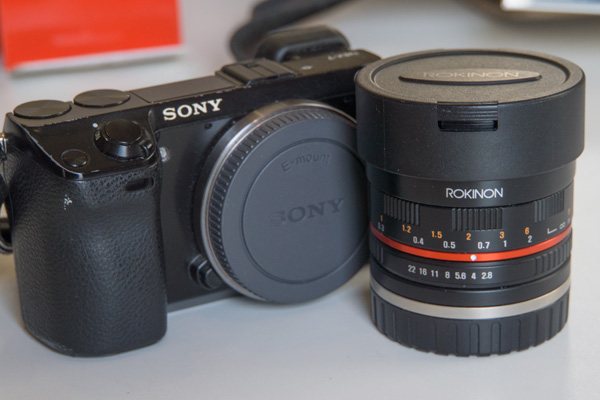 The Nex7 is very compact and lightweight. The Rokinon 8mm fisheye is also surprisingly compact. |
|
|
|
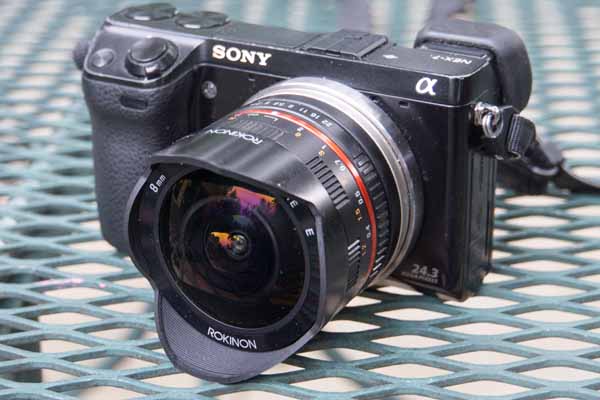 The Sony Nex7/Rokinon 8mm setup is only about 1/3 the size of my Canon 6D with a Canon 8-15mm fisheye – a true space and weight saver. |
 One of the first images that I recorded with the new lens was in the Tetons. I especially like the curved horizon. |
|
|
|
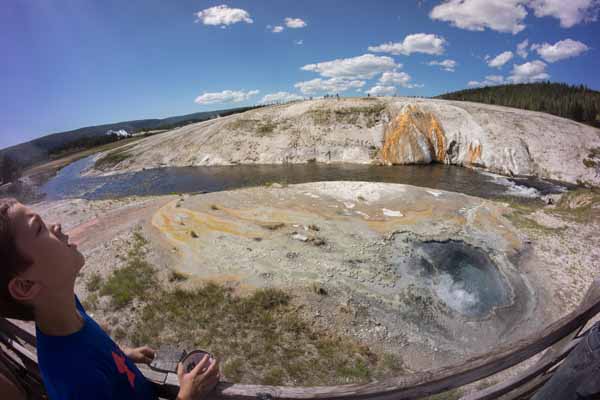 Here in Yellowstone you can see that the bridge rail curves upwards. The lens does not support the camera’s autofocus feature. |
 However an 8mm lens has a very wide depth of field which makes focusing less critical as you can see in this image taken at Mono Lake. |
|
|
|
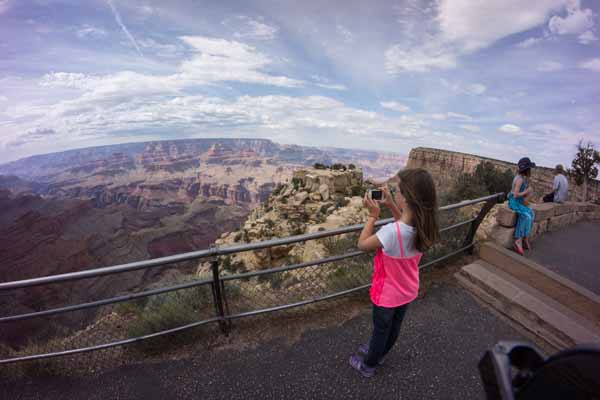 At Grand Canyon, the bend in the horizon is amazingly scenic. The lens does not support autoexposure so I set the camera shooting mode to manual, set the lens aperture to f/8 and adjusted to the proper shutter speed. |
 In both of these photos, you can see that the exposure for both a shaded and sunny scene were correct. Neither the manual focus nor the manual exposure requirements of this lens is a concern. |
|
|
|
 At Monument Valley I took advantage of the lens’ extreme wide view. Here I was able to take in a 180-degree view to photograph this huge monument within a single image. |
 The fisheye excels for those of you who like shooting portraits that include the vast surroundings. |
|
|
|
 At Mesa Verde, we encountered another “tight squeeze”. However, we were able to capture this with the lens’ wide view. |
 In Rocky Mountain National Park, the lens took in not only the winter’s left over snow but the billowing overhead July clouds. |
|
|
|
| What about the sharpness?
Here I’ve enlarged a small section of one of the above images. You can clearly see the detail in the face, the lettering of the cap and the tufa formations in the background. I found the sharpness of this inexpensive lens to be very acceptable. |
 |
|
|
|
After my short time with this lens, I am no longer skeptical of it’s quality. The images are tack sharp with very good color reproduction. If you’re on the lookout for an ultra-wide, include this lens in your search.
The Rokinon 8mm f/2.8 fisheye is also available for other camera models as well: Fuji, Samsung and Canon M mount. Other similar versions with a maximum f/3.5 aperture are available for Canon, Nikon, Sony A mount, Pentax and Olympus 4/3.
Written by: Arnie Lee
Getting Personal
03rd December 2013
Camera Brands are like Religion
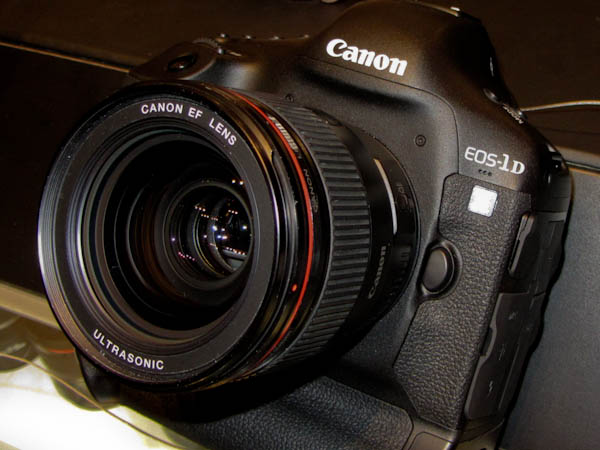
Not a week goes by without someone asking me what brand of camera they should buy, a Canon or a Nikon.
Most of the time they’re wanting to replace their good quality point-and shoot camera. They’re looking for more advanced equipment along the lines of a DSLR.
Having owned or used literally dozens of cameras, especially in the past five years, I have a definitive answer which I’ll share with you shortly. But what I find interesting is that so many photo enthusiasts also have very definite answers to this question.
Let me back up a bit and explain why I’m writing this.
A Facebook friend wrote that he was looking for a new DLSR. “Should I buy a Canon or a Nikon?”, he posted. I replied “or a Sony?”. The point I was trying to make was that there are more choices than only Canon and Nikon.
A few minutes later there were many more replies on his Facebook status: “Nikon”; “CanonCanonCanon”; “I shoot Nikon”; “I use a Nikon D90”; “Canon definitely”; “I have a Nikon 5000”; etc.
 |
 |
 |
It’s not surprising that a camera brand is a very personal choice. It is as though each photographer is pleading with my friend to heed only his or her suggestion. Isn’t proselytizing their brand like forcing a person’s religion onto another?
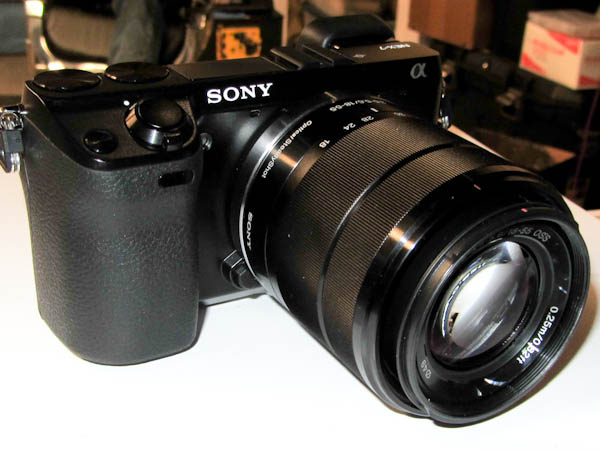
Yet when I think about it I was doing the same. I was suggesting that a Sony NEX camera is similar to DSLR but without the weight and bulk. And since I am very fond of carrying lightweight equipment, I frequently use a Sony NEX camera.
Of course I could have chosen a different way to respond to his initial post by asking a few qualifying questions: will he be taking lots of sports or action; are movies part of his photography repertoire; how much money does he have to spend.
But frankly these qualifying questions don’t matter much.
Here’s my answer to his question: it doesn’t matter if you choose Canon or Nikon. Both have equally capable cameras in the various price ranges. And Sony also has equally capable cameras. One could argue that Pentax and Olympus also offer quality models too.
There’s too many slanted opinions for my friend to make his choice based on all of the Facebook replies. I hope my friend makes his choice based on how the equipment feels in his hands; getting the most features for the price; availability and affordability of additional lenses; past experience with previous purchases.
What do you think? Any comments?
Written by: Arnie Lee
« Older Posts — Newer Posts »